
The European Union is pushing online platforms like Google and Meta to step up the fight against false information by adding labels to text, photos and other content generated by artificial intelligence, a top official said Monday.
Source: “Is it real or made by AI? Europe wants a label for that as it fights disinformation” (AP News)
I can understand the intention but trying to enforce labels in order to identify “AI-generated content” is futile and misses the point.
Firstly, AI is progressing at an unbelievably fast pace. Governments, at least using the climate emergency as a yardstick, are not. The AI horse has left the stable and by the time any guidelines or regulations are complete, the novelty of a machine producing content by itself will have worn off and we’ll just assume everything is completely or partially AI-generated.
Which leads to the second point, that AI-generation is not black and white – it’s a sliding scale, like most creative activities. If a carpenter uses an electric drill, is the furniture they produce machine-made? If AI wrote a paragraph or two of this blog post, would it need an “AI-generated” label? What if AI just drafted the initial outline? Or just came up with the idea? Or translated it? It’s no wonder the accuracy of AI detection software is laughable.
A more practical alternative would be a “Human-generated content” label. While still susceptible to the sliding-scale issue, at least there’s a vague precedent in the form of organic certification. But unlike organic vegetables whose growing conditions can be tested, content can’t be proven to be purely human-generated so the label would have to be self-certified, and therefore prone to abuse.
Finally, part of me thinks that with artificial intelligence overtaking human intelligence very soon (if not already, behind closed doors), is worrying about labels the best use of government resources?
I don’t know the solution (maybe we should ask AI?), other than a need to be even more sceptical of content presented to us as factual. But I’m hopeful that, as with previous technological revolutions, the benefits will outweigh the disadvantages. Unlike those revolutions, however, this one will result in us no longer being the dominant “species” on this planet. Now how do you regulate for that?
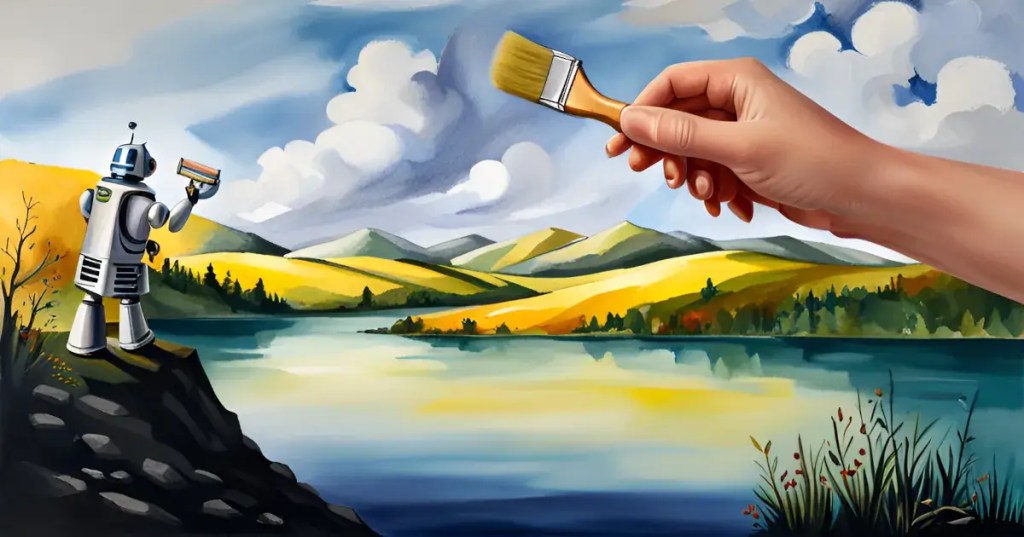
This content is human-generated except the title and image, with all its fingers.
 Daniemon's Blog
I agree! Specially with “we’ll just assume everything is completely or partially AI-generated” and “a need to be even more sceptical of content presented to us as factual”. As I have said: simply assume none of what those models produce is “true” or “right”, and most problems are solved.
I too think legislating labels is pointless and too intrusive. My own approach is to socially encourage and develop an “AI-tiquette”, and marginalise individuals and organisations that push nefarious or deceptive content on purpose: https://blog.tripu.info/ai-tiquette
/human
LikeLiked by 1 person
“AI-tiquette” – love it! You should be in marketing 🙂
I think a voluntary solution is a decent compromise. Fewer legal hurdles, less open to abuse, and for those that do follow the AI-tiquette it also sends a signal of trust.
LikeLike